Check out our White Paper Series!
A complete library of helpful advice and survival guides for every aspect of system monitoring and control.
1-800-693-0351
Have a specific question? Ask our team of expert engineers and get a specific answer!
Sign up for the next DPS Factory Training!
Whether you're new to our equipment or you've used it for years, DPS factory training is the best way to get more from your monitoring.
Reserve Your Seat TodayAn Iowa casino surveillance team needed a door and panic button alarm monitoring system that could start at about 60 active points and scale to roughly 80. DPS Telecom recommended a NetGuardian RTU solution centered on the NetGuardian 420 with NetGuardian DX discrete-input expansion to support growth while keeping the operator experience familiar.
| Industry | Casino surveillance and security |
|---|---|
| Company Type | Casino property (surveillance technician-led project) |
| Geography/Coverage | Iowa (single casino property) |
| Primary Challenge | Monitor door contacts and panic buttons (about 60 active alarms today) with a plan to expand to about 80 total, while keeping the interface similar to a previously used NetGuardian M16 and staying under a $2.5K budget. |
| Solution Deployed | Recommended a mid-sized RTU with expansion capability: NetGuardian 420 with NetGuardian DX discrete input expansion, plus an interface demo to address user adoption concerns. |
| Products Used | NetGuardian 420; NetGuardian M16 (reference point from prior property); NetGuardian 832 DX G5 |
| Key Result | A scalable design that could meet the casino's door and panic monitoring requirements while minimizing the learning curve and avoiding the complexity of deploying multiple standalone RTUs. |
DPS Telecom frequently supports casinos and similar facilities where surveillance teams need immediate visibility into safety and security events. In this project, a Surveillance Technician at an Iowa casino (referred to here as "Adam") reached out after working with DPS equipment at a previous property.
Adam was already using Surveillus at the casino and had previously used Surveillus with DPS Telecom alarm systems. His request was straightforward: pricing and a practical design for door and panic alarms that could grow over time.
The casino had about 60 active alarms made up of door contacts and panic buttons, with plans to expand to around 80 total. The monitoring system needed to handle dry contact inputs (simple open/closed circuits typical of doors and emergency buttons) and present alarms in a way that surveillance staff could quickly interpret and act on.
In addition to capacity, the project had two real-world constraints:
When these constraints combine, a common pitfall is selecting a device that works for the initial point count but forces a forklift upgrade (or multiple devices) once expansion begins. DPS Telecom's goal was to recommend a design that would meet current needs while keeping expansion simple and predictable.
DPS Telecom recommended the NetGuardian 420 as the primary RTU because it fits the size of the project while providing a clear path to expand input capacity without deploying multiple independent base units.
On its own, the NetGuardian 420 provides:
More importantly for this casino, the NetGuardian 420 supports add-on expansion to increase discrete point count as needs grow. When combined with expansions, it can monitor up to 164 discrete points.
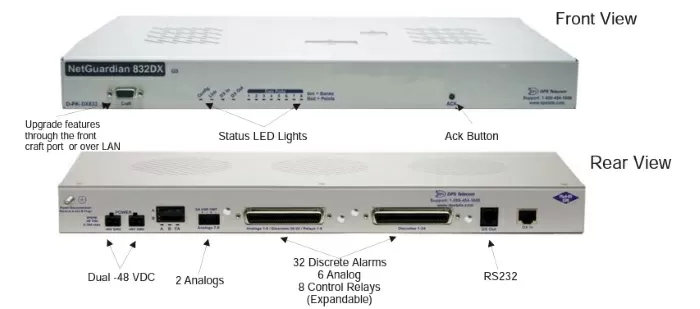
To add discrete alarm points at low cost and with straightforward wiring, DPS Telecom also recommended a NetGuardian DX expansion unit - specifically the NetGuardian 832 DX G5. This self-contained expansion chassis adds more discrete alarm points and provides additional relays and analog capacity per chassis.
The recommended approach was to size the base RTU for the initial deployment, then add DX expansions only as the point count grows. DX expansions can be daisy chained (up to three) to support future growth without changing the core monitoring workflow.
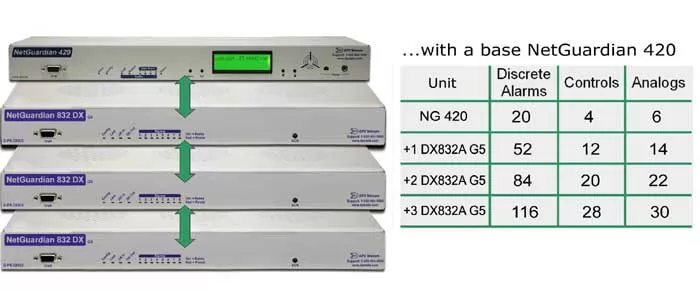
Why this matters operationally: expanding a single RTU with DX units keeps alarm presentation consolidated and avoids splitting alarms across multiple independent devices, IP addresses, and configuration sets. That consolidation is especially valuable for surveillance and security teams that need fast recognition and response during an incident.
Two days after the discovery call, DPS Telecom sent a proposal that documented the casino's requirements and mapped them to a scalable device plan. The proposal emphasized:
DPS Telecom also highlighted a practical benefit for operations and maintenance: a telco-grade, US-manufactured RTU designed for high reliability monitoring in long-lived deployments.
After reviewing the proposal, Adam raised a reasonable concern: the NetGuardian 420 interface is not identical to the NetGuardian M16 interface he had used before. While one of DPS Telecom's other sales engineers discussed the quote with him during a brief scheduling gap, the core technical guidance remained consistent - use an expandable RTU so the casino can scale point counts without multiplying devices.
DPS Telecom clarified that the NetGuardian 420 interface is similar enough to keep the learning curve small, and that the 420 is better suited to the project because it starts with more inputs and supports expansions. In contrast, the NetGuardian M16 is often a better fit for smaller projects because it has 16 inputs and cannot be used with expansions.
For the casino's goal of monitoring around 80 sensors, using only NetGuardian M16 hardware would require five separate M16 units. The proposed alternative - one NetGuardian 420 (20 dry contact inputs) with two DX expansions (adding 64 dry contact inputs each) - would provide the needed capacity with additional spare inputs available for growth.
To make adoption easier, DPS Telecom offered a demo of the NetGuardian 420 interface to review day-to-day alarm use and explain the minor differences versus the M16.

The outcome of this engagement was a clear, scalable monitoring plan for door contacts and panic buttons that aligned with the casino's point-count growth targets and operator preferences. The recommended design minimized complexity by keeping alarms consolidated on a single expandable RTU rather than distributing points across multiple standalone units.
For similar surveillance projects, this architecture typically supports better standardization: fewer base devices to configure, a consistent alarm presentation for operators, and a straightforward expansion path as additional doors or panic locations are added.
What is a "dry contact" input for door and panic monitoring?
A dry contact is a simple open/closed circuit from a switch or relay. Door contacts and panic buttons commonly present as dry contacts, making discrete inputs on a NetGuardian RTU a direct fit.
How does a casino surveillance team typically use alarm monitoring alongside video?
Many facilities pair alarm monitoring with surveillance software so operators can see an alarm event (door forced, panic pressed) and then quickly verify conditions using cameras and procedures. In this project, the surveillance technician noted prior experience using Surveillus with DPS alarm systems.
Why not just use multiple small RTUs instead of one expandable RTU?
Multiple devices can increase configuration and maintenance overhead. A single expandable RTU can keep alarm points more centralized, which can simplify day-to-day operations and future growth.
How do DX expansions increase input capacity?
DX expansion units add additional discrete points in a separate chassis and connect back to the base RTU. For the NetGuardian 420, DX expansions can be daisy chained (up to three) as point counts increase.
What should I consider when planning for 60 to 80 alarm points?
Account for growth, spare capacity, wiring topology, and how operators will acknowledge and track alarms. DPS Telecom RTUs are designed to make it practical to start at a smaller point count and add inputs later without replacing the core system.
If you are planning a door and panic button monitoring project for a casino or other security-sensitive facility, DPS Telecom can help you choose the right NetGuardian RTU and expansion approach. Get a Free Consultation or call 1-800-693-0351 to speak with an expert about your project. You can also email sales@dpstele.com or call 559-454-1600.

Andrew Erickson
Andrew Erickson is an Application Engineer at DPS Telecom, a manufacturer of semi-custom remote alarm monitoring systems based in Fresno, California. Andrew brings more than 19 years of experience building site monitoring solutions, developing intuitive user interfaces and documentation, and opt...