Check out our White Paper Series!
A complete library of helpful advice and survival guides for every aspect of system monitoring and control.
1-800-693-0351
Have a specific question? Ask our team of expert engineers and get a specific answer!
Sign up for the next DPS Factory Training!
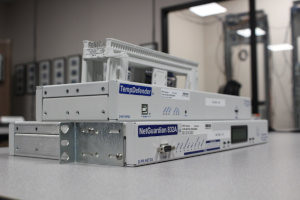
Whether you're new to our equipment or you've used it for years, DPS factory training is the best way to get more from your monitoring.
Reserve Your Seat TodayThese two platforms both show up in remote monitoring conversations, and on the surface they appear comparable: both are U.S.-manufactured, both have been around since the mid-1980s, and both monitor environmental and equipment conditions at remote sites. In practice, they are built for very different jobs.
Sensaphone describes the IMS-4000 as an enterprise environmental monitoring system for server rooms and IT facilities. DPS Telecom's platform (anchored by the NetGuardian 832A G6 RTU and T/Mon master station) is a full RTU-to-NOC architecture built for telecom carriers, utilities, and multi-site critical infrastructure. We've deployed over 172,000 devices across more than 1,500 companies. Many organizations begin with room-level monitoring (such as NetGuardians and similar RTUs) and later adopt network-wide monitoring platforms (such as T/Mon) as their infrastructure footprint grows.
This comparison covers the factual differences across every major evaluation category. Specs and pricing were gathered from published product documentation from both manufacturers; some details may have changed since this article was written.
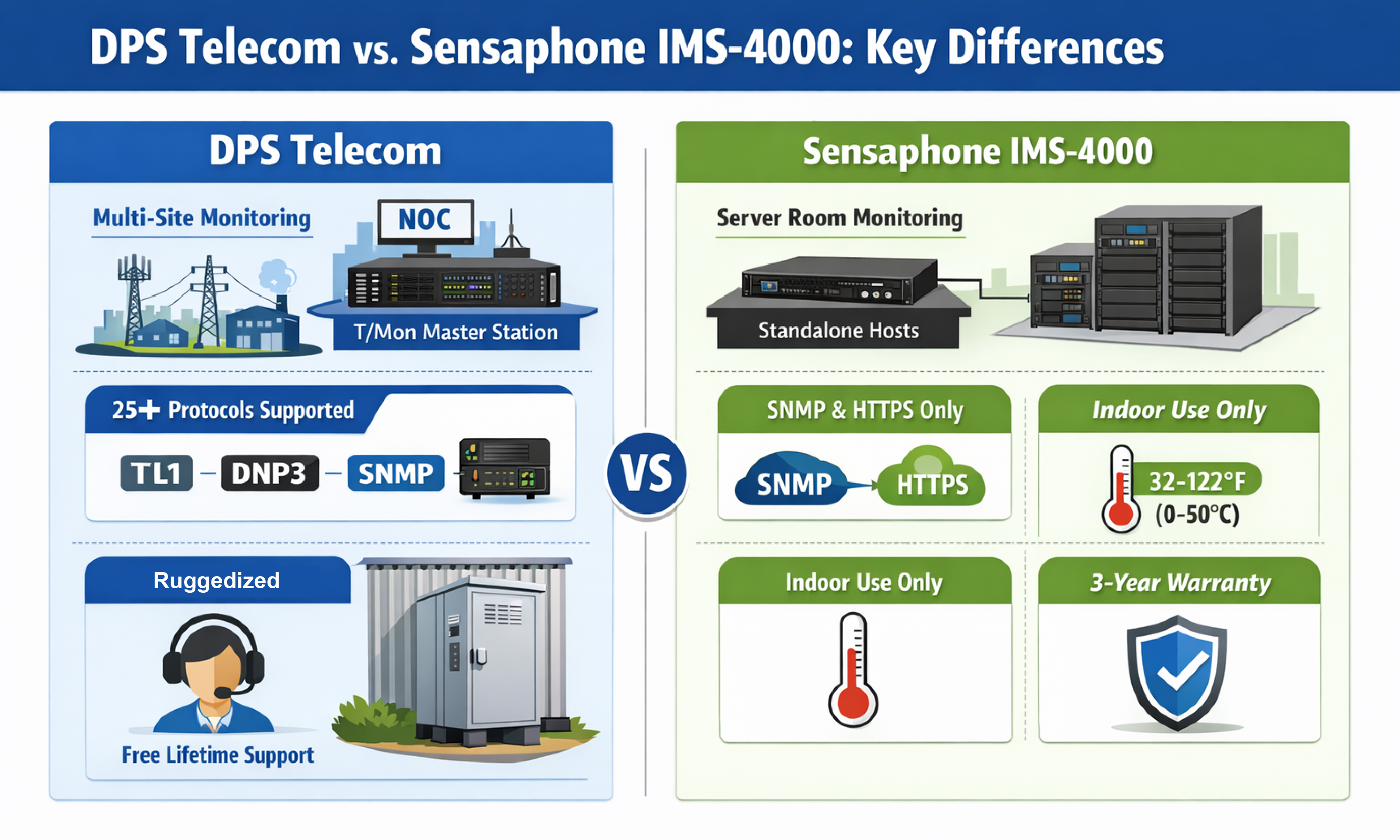
Before getting into the details, here is a summary of where the two platforms differ most.
| Category | DPS Telecom | Sensaphone IMS-4000E |
|---|---|---|
| Primary use case | Multi-site critical infrastructure: telecom, utilities, transit | Server rooms and small data centers |
| Centralized management | T/Mon LNX: up to 9,999 devices / 999,999 alarm points | None; ConsoleView manages individual hosts only |
| Protocol support | 25+, including TL1, TBOS, DNP3, Modbus, SNMP | SNMP traps, HTTPS, SMTP |
| NEBS compliance | Self-certified; third-party lab option available | Not claimed |
| Operating temperature | 32-140°F (0-60°C) | 32-122°F (0-50°C) |
| Sensor interfaces | Industry-standard 0-5 VDC and 4-20 mA | Proprietary RJ-45 sensors |
| Support model | Free lifetime tech support; 30-day loaner program | 3-year warranty |
| Starting price | ~$700 (RTU); ~$2,000-$5,000 per site | ~$2,010 (host unit, sensors sold separately) |
The table above captures the shape of the comparison. The sections below explain what those differences mean in a real deployment.
The most fundamental difference between these two platforms is how they are designed to grow.
DPS Telecom follows a hierarchical RTU-to-master model. NetGuardian RTUs deploy at remote sites (cell towers, substations, central offices, pump stations) and report upstream to a T/Mon master station at the NOC. T/Mon is available in four tiers to match different scales:
| T/Mon Tier | Capacity |
|---|---|
| T/Mon MINI | Up to 16 devices |
| T/Mon SLIM | Up to 64 devices / 10,000 alarm points (1 RU) |
| T/Mon LNX | Up to 9,999 devices / 999,999 alarm points (4 RU) |
| T/Mon NOC | Up to 1,000,000 discrete alarm points (server-class) |
Multiple T/Mon units can be chained in a master-of-masters (MOM) configuration, allowing regional NOCs to roll up into a national operations center with selective alarm filtering and forwarding. The platform also includes geographic alarm mapping via T/GFX, root cause analysis, trend analysis, alarm qualification, and a SQL database for configuration history.
The Sensaphone IMS-4000 uses a hub-and-spoke model: one host connects to up to 31 expansion nodes over Ethernet, with each node adding 8 sensor inputs for a maximum of 256 environmental sensors per host. ConsoleView PC software can manage multiple hosts, but published IMS-4000 documentation focuses on monitoring within a host/node environment rather than describing a centralized NOC architecture.. For organizations monitoring a larger number of locations, this may require managing multiple independent host units without a unified operational view.
Protocol support is where the gap between these platforms is most pronounced. It reflects the different environments each system was designed to monitor, and it has the most direct practical impact for organizations running mixed-vendor or multi-generational equipment.
Our T/Mon master station supports 25+ inbound protocols, including:
Published Sensaphone documentation shows the IMS-4000 supports SNMP traps, HTTPS, and SMTP. TL1, TBOS, TABS, E2A, DNP3, and Modbus are not included in published IMS-4000 specs.
For organizations monitoring climate-controlled server rooms with modern IP equipment only, the IMS-4000's protocol set may be sufficient. For organizations running telecom or utility infrastructure that includes proprietary or serial-protocol equipment alongside modern gear, this is a meaningful constraint worth evaluating before committing to a platform.
When a carrier runs a mix of serial-protocol equipment alongside modern SNMP gear, they need a monitoring platform that can communicate with both without requiring a forklift replacement of functioning infrastructure. Our T/Mon can collect alarms in any supported protocol and forward them in a unified format to the NOC, which may allow organizations to continue using existing equipment rather than replacing it solely for compatibility. There is no documented equivalent capability in the Sensaphone IMS-4000 ecosystem.
The hardware specs on each platform reinforce the same architecture divide.
| Specification | DPS Telecom (NetGuardian 832A G6) | Sensaphone IMS-4000E |
|---|---|---|
| Discrete alarm inputs | 32 per RTU, expandable to 176 via DX modules | 8 per host, expandable to 256 via 31 nodes |
| Analog inputs | 8 per RTU (expandable to 12); 0-5 VDC and 4-20 mA | 8 per host; proprietary RJ-45 sensors |
| Control relay outputs | 8 per RTU (expandable to 12) | Optional add-on; 2 relays per IMS-4310 unit |
| IP/ping monitoring | 32 targets per RTU | 64 targets per host/node; 2,048 system-wide |
| Serial/terminal server ports | Up to 8 RS-232 ports for reach-through to serial devices | Not included |
| Transport options | Dual Ethernet, fiber (SFP), T1/E1, cellular, dial-up, serial | Ethernet 10/100, analog phone line, RS-232 (config only) |
| Power input | -48 VDC, +24 VDC, AC, PoE (DIN model) | 9 VDC plug-in supply with 6V gel cell backup |
(Specifications summarized from manufacturer documentation as of 2026)
The serial terminal server ports are worth noting. They allow a technician to reach through the NetGuardian to access serial-connected legacy devices remotely, without a separate terminal server. The IMS-4000 has no equivalent capability.
For equipment deployed in telecom central offices, utility substations, and outdoor cabinets, NEBS (Network Equipment-Building System) compliance can be a hard procurement requirement. NEBS Level 3, the highest tier, specifies standards for fire resistance, thermal shock, seismic vibration, EMI, and airflow as defined in Telcordia GR-63-CORE and GR-1089-CORE. Carriers including AT&T, Verizon, and CenturyLink typically require NEBS Level 3 for equipment installed in central offices.
| DPS Telecom | Sensaphone IMS-4000E | |
|---|---|---|
| NEBS compliance | Self-certified; third-party lab certification available on request | Not claimed |
| Certifications | NEBS (in-house testing: anechoic chamber, vibration, thermal/drop) | FCC Part 15 Class A, FCC Part 68, UL/CSA |
| Operating temperature | 32-140°F (0-60°C) | 32-122°F (0-50°C) |
| Designed for | Uncontrolled telecom outside-plant and industrial environments: outdoor cabinets, unheated huts, hot shelters | Climate-controlled indoor spaces |
The 18°F difference in upper operating temperature may seem modest, but it reflects a meaningful engineering difference. Equipment shelters and outdoor cabinets routinely exceed 120°F in summer conditions, and the NetGuardian 832A G6 is tested for that.
The IMS-4000 uses proprietary RJ-45-connected sensors specific to the IMS product line. Published product documentation indicates that standard dry contact inputs may require an IMS-4850 bridge, and 4-20 mA signals may require an IMS-4851 bridge. IMS sensors are designed as part of a proprietary ecosystem, while NetGuardian units almost always accept standard industrial interfaces by default without an expansion unit (expansions or larger NetGuardian models merely increase capacity).
Our NetGuardian RTUs use industry-standard 0-5 VDC and 4-20 mA interfaces. Third-party industrial sensors (pressure transducers, flow meters, fuel level sensors) connect directly without proprietary adapters. We also operate as a semi-custom manufacturer: every product we sell is built to order, with the NetGuardian 832A G6 available in over 50 build configurations. Custom engineering carries no NRE (non-recurring engineering) fees, provided a minimum order quantity is met.
| DPS Telecom | Sensaphone IMS-4000E | |
|---|---|---|
| Encryption | SNMPv3, HTTPS/SSL | HTTPS |
| Authentication | RADIUS, IP whitelisting, 8 configurable user accounts | Basic password protection |
For organizations with security-conscious procurement requirements, particularly government agencies or carriers, the RADIUS authentication and IP whitelisting on the NetGuardian G6 series may be relevant evaluation criteria.
We provide free lifetime technical support from our engineering team in Fresno, California, the same engineers who design the products. We also offer:
Clients like Consolidated Communications have had units deployed since 1999, and we frequently hear from clients whose deployments have run for over 20 years. One client reported approximately a 1% failure rate across 160 units over six years.
Sensaphone offers a 3-year warranty on the IMS-4000E and technical support through their Aston, Pennsylvania team. Sensaphone reports nearly 500,000 systems in use worldwide across their product lines. Their published documentation does not describe a loaner program, factory training, or lifetime support commitment comparable to what we offer.
On pricing, our basic RTUs start around $700, with typical site deployments in the $2,000-$5,000 range including the RTU, sensors, and configuration. The IMS-4000E host unit carries a published MSRP of approximately $2,010 before sensors, nodes, or accessories, and does not include any centralized master station, as none is available in the Sensaphone IMS ecosystem.
The Sensaphone IMS-4000 can be a practical choice for organizations that need temperature, humidity, and power status alerts in climate-controlled server rooms, particularly where modern IP equipment and a standalone web interface cover the full scope of the requirement.
For organizations monitoring distributed sites at scale (telecom networks, power utilities, data center operations with multi-site infrastructure, or any environment with proprietary or serial-protocol equipment) the IMS-4000 architecture may hit limits at the points that matter most: protocol support, centralized management, environmental hardening, and long-term scalability.
We built our platform for organizations that cannot afford monitoring blind spots. If that describes your operation, we're glad to walk through what a deployment would look like for your environment.
Contact our engineering team to discuss your monitoring requirements.

Andrew Erickson
Andrew Erickson is an Application Engineer at DPS Telecom, a manufacturer of semi-custom remote alarm monitoring systems based in Fresno, California. Andrew brings more than 19 years of experience building site monitoring solutions, developing intuitive user interfaces and documentation, and opt...