Check out our White Paper Series!
A complete library of helpful advice and survival guides for every aspect of system monitoring and control.
1-800-693-0351
Have a specific question? Ask our team of expert engineers and get a specific answer!
Sign up for the next DPS Factory Training!
Whether you're new to our equipment or you've used it for years, DPS factory training is the best way to get more from your monitoring.
Reserve Your Seat Today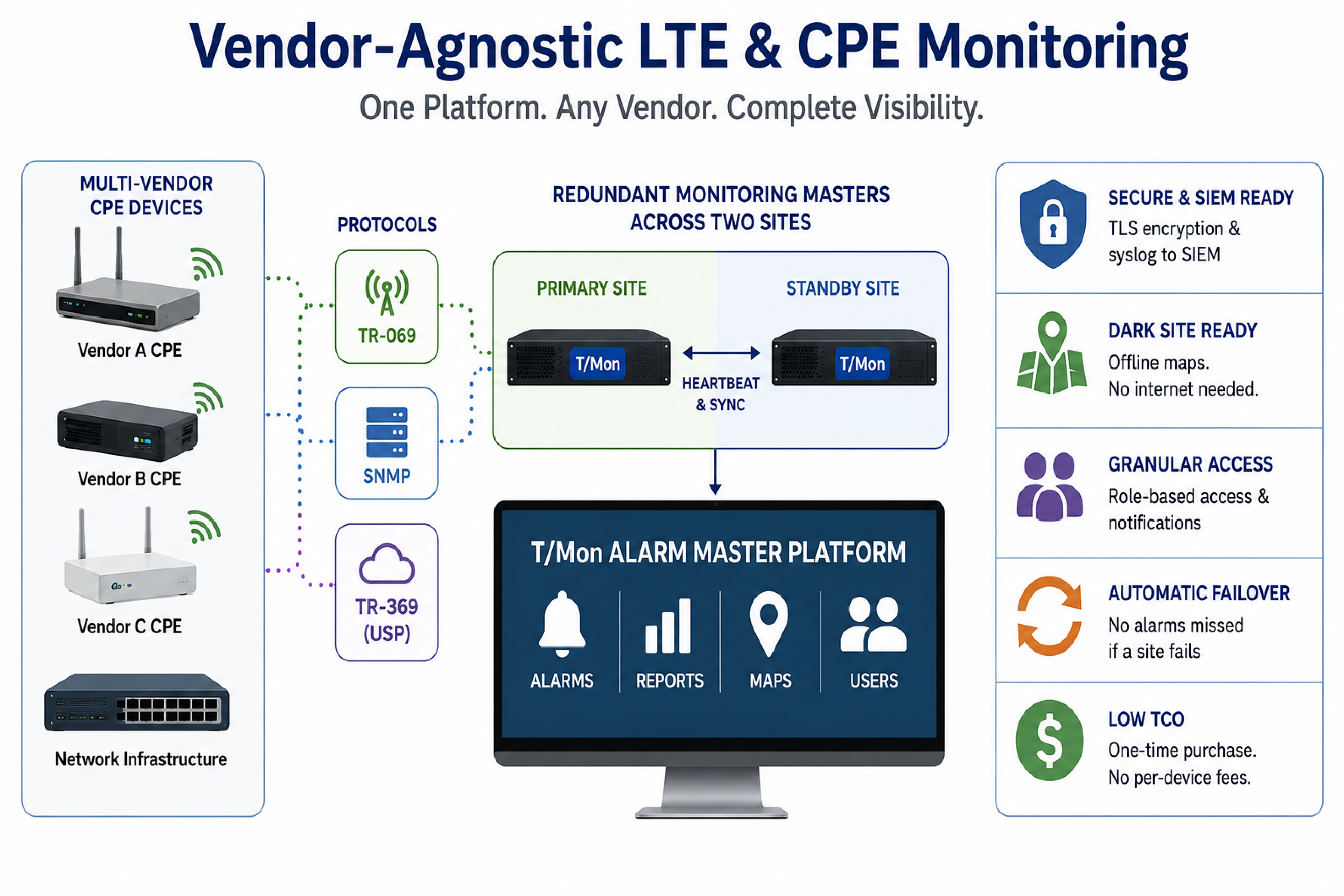
Vendor-agnostic monitoring is the ability to watch equipment from many different manufacturers through one system, regardless of which protocols or data models each device uses. For an operator running thousands of customer premises equipment (CPE) devices across an LTE network, this matters more than any single feature, because the alternative is a separate management tool for every vendor.
This article explains how to monitor a large, multi-vendor CPE fleet from a single platform, why protocol breadth and redundancy decide whether such a system holds up at scale, and how to satisfy the security, access-control, and reporting requirements that large enterprises bring to a monitoring purchase. It is written for network and security teams evaluating a replacement for an existing SNMP or device-management platform.
Vendor-agnostic CPE monitoring is the collection of status and performance data from customer premises equipment made by different manufacturers, normalized into one consistent alarm and reporting view. The goal is a single operational picture rather than a patchwork of vendor-specific dashboards.
Large LTE deployments rarely use a single CPE vendor. Devices report active status and performance values - signal strength, RSSI, and similar measurements - but they do so through different protocols and data models. A monitoring platform that is tied to one vendor or one protocol cannot give a unified view. A platform such as a T/Mon alarm master from DPS Telecom is designed to collect from mixed-vendor equipment and present it through one interface, so operations staff work from a single system instead of several.
The practical test of vendor-agnostic monitoring is simple: when a new device type is added to the network, can the system monitor it without replacing the platform? If the answer is yes, the operator keeps one tool as the network grows and diversifies.
Protocol support is the set of communication standards a monitoring system can use to reach and interpret devices. In LTE and CPE environments, two families dominate, and a third is emerging.
A monitoring system that handles both TR-069 and SNMP - the same standards used by many remote telemetry units on the network - covers the large majority of a mixed CPE fleet today, while a path toward TR-369 protects the investment as devices modernize. Where a device exposes data through a manufacturer-specific or custom module, that data can often be brought in by building a device profile from the device's SNMP MIB, protocol specification, or the nearest existing module - through protocol mediation, so even unusual equipment fits the same monitoring view.
Monitoring redundancy is a design in which a second system can take over if the primary fails, so visibility is never lost. For an operator that manages its network as one environment but runs geo-redundant locations, the monitoring layer should mirror that resilience.
A common architecture uses two central master stations across two sites in an active/standby relationship:
At very large device counts, load - not database capacity - is the design concern. A single master can hold thousands of devices, but heavy simultaneous traffic during a major event or alarm storm is what stresses a system. For the largest networks, multiple masters can feed a central master in a tree, distributing collection load while preserving one consolidated view. Confirming the right topology for a specific device count and expected traffic is an engineering exercise, not a guess.
Granular access control is the ability to limit each user to only the devices and alarms relevant to their team. In large organizations, many internal groups share one monitoring environment but should each see only their own equipment.
Effective access control in a monitoring master typically includes:
A realistic example is a handful of internal groups, each with its own short list of email recipients, plus a case where one mobile group moves between locations on its CPEs and needs to be alerted if a device drops during that movement. Tying alarm points and point groups to specific recipients covers these patterns without custom development.
A dark site is a facility with no external internet connectivity, common in high-security and critical-infrastructure environments. A monitoring platform deployed there must provide its full function, including map views, entirely from internal resources.
Map displays that normally pull tiles from an online service can instead use an offline tile server hosted on the internal network. The map data is stored locally, so geographic views of sites and devices work without any outside connection. This is a routine requirement in secure environments, and planning for a local tile server during design avoids a feature gap after deployment. Keeping the master on-premises rather than in a cloud service also fits the dark-site model, since the system does not depend on outside reachability to operate.
Enterprise security integration is the set of capabilities that let a monitoring appliance pass an organization's vulnerability assessment and feed its security tooling. Large enterprises run commercial security teams that scan every appliance for issues such as deprecated software, outdated web-server versions, certificate problems, and TLS standards.
Several characteristics help a monitoring platform meet these expectations:
| Security Requirement | Platform Capability |
|---|---|
| Hardened operating system | A Linux-based master, with an enterprise option such as Red Hat Enterprise Linux for the most security-sensitive deployments. |
| Current encryption standards | Support for current TLS standards and custom certificates for management interfaces. |
| Remediation of scan findings | A vendor that works with customers when scans flag items, and addresses findings proactively rather than refusing updates. |
| Northbound syslog to a SIEM | A syslog responder that forwards events northbound to the organization's security information and event management system. |
The syslog point is increasingly common: the security team wants monitoring events delivered into the SIEM alongside everything else. Treating the monitoring platform as security documents its cybersecurity approach - encryption, certificates, and proactive remediation - is what keeps it from becoming the weak point a vulnerability scan flags.
Total cost of ownership is the full cost of a monitoring system over its life, not just the purchase price. The licensing model matters as much as the sticker price, because recurring per-device fees can dominate the long-term cost of a large fleet.
A one-time purchase model works differently from a subscription. The system is bought once as combined hardware and software and continues to operate whether or not optional maintenance is renewed. Maintenance, when purchased, covers software updates and is typically priced as a percentage of the system cost, with multi-year terms discounted relative to paying annually. For a large device count, the key contrast is the absence of repeated per-device license fees - the cost does not scale upward simply because the fleet grows, which is a meaningful difference from platforms structured around recurring device licensing.
Current device module libraries are generally included with a new purchase, and custom device modules for unusual equipment can often be folded into a large project, sometimes as a defined allowance of future module credits. This keeps the cost of supporting new or custom devices predictable rather than open-ended.
Yes. A vendor-agnostic master collects from mixed-vendor equipment and normalizes it into one view. Devices that use different protocols or data models are brought into the same alarm and reporting interface, so operations work from a single system rather than several vendor tools.
Both are supported. TR-069 carries CPE status and reported values such as signal strength, while SNMP covers devices that do not implement TR-069 and much of the network infrastructure. A platform handling both covers the majority of a mixed fleet, with TR-369 as the emerging successor to plan for.
Two masters run in an active/standby relationship across geo-redundant locations. If the primary fails, the secondary takes over, including resuming polling and listening for asynchronous traffic such as SNMP traps, so no alarms are missed during the switch.
Yes. Map tiles and other normally-online features can run from an internal offline tile server, and the on-premises master does not depend on outside connectivity to operate. Dark-site deployment is a routine requirement in secure environments.
Yes, through northbound syslog forwarding. A syslog responder sends monitoring events to the organization's SIEM, so the security team sees them alongside other security data. The platform also supports current TLS standards and custom certificates for passing vulnerability assessments.
No. The system is a one-time hardware-and-software purchase that keeps operating without renewal. Optional maintenance covers software updates and is priced as a percentage of system cost, with multi-year discounts, but the cost does not scale up with each added device.
If you are managing thousands of multi-vendor CPE devices and weighing a platform that can unify them - across TR-069, SNMP, redundant sites, dark-site constraints, and a SIEM-integrated security review - the right next step is to map your specific device list and architecture to a sized design. DPS Telecom can confirm protocol coverage, model the redundancy and load topology for your device count, and document how the platform meets your security team's requirements. Get a Free Consultation, or call 1-800-693-0351 or email sales@dpstele.com to start with your monitoring requirements.

Andrew Erickson
Andrew Erickson is an Application Engineer at DPS Telecom, a manufacturer of semi-custom remote alarm monitoring systems based in Fresno, California. Andrew brings more than 19 years of experience building site monitoring solutions, developing intuitive user interfaces and documentation, and opt...