Download our free Monitoring Fundamentals Tutorial.
An introduction to Monitoring Fundamentals strictly from the perspective of telecom network alarm management.
1-800-693-0351
Have a specific question? Ask our team of expert engineers and get a specific answer!
Sign up for the next DPS Factory Training!
Whether you're new to our equipment or you've used it for years, DPS factory training is the best way to get more from your monitoring.
Reserve Your Seat TodaySubheadline: How a small team monitors a massive territory without missing a beat.
| Field | Details |
|---|---|
| Industry | Telecommunications Cooperative |
| Company Type | Rural telephone & broadband provider |
| Geography/Coverage | 7,200+ sq. miles across Oklahoma & Texas |
| Primary Challenge | Monitoring many remote sites with a small team |
| Solution Deployed | NetGuardian RTUs + T/Mon LNX master station |
| Key Result | Instant alerts for power, HVAC, door, and generator events |
| Products Used | NetGuardian 480, NetGuardian M16, NetGuardian 832A G4, T/Mon LNX |
Founded in 1954, Panhandle Telephone Cooperative, Inc. (PTCI) provides telephone, broadband, and 4G LTE wireless service across the three counties of the Oklahoma Panhandle. They are currently building out fiber-to-the-home (FTTH) to all of their exchanges and also serve portions of Texas.
PTCI covers nearly 200 miles east-to-west across the Oklahoma Panhandle and into Texas - a vast service territory managed by a team of roughly nine technicians spread across four locations. With numerous COs, cell sites, and remote installations to oversee, the team needed a way to detect problems immediately without sending technicians out on unnecessary trips.
"We have a bunch of COs, lots of cell sites, and lots of remotes." - Jason Kueffler, Broadband Network Technician, PTCI
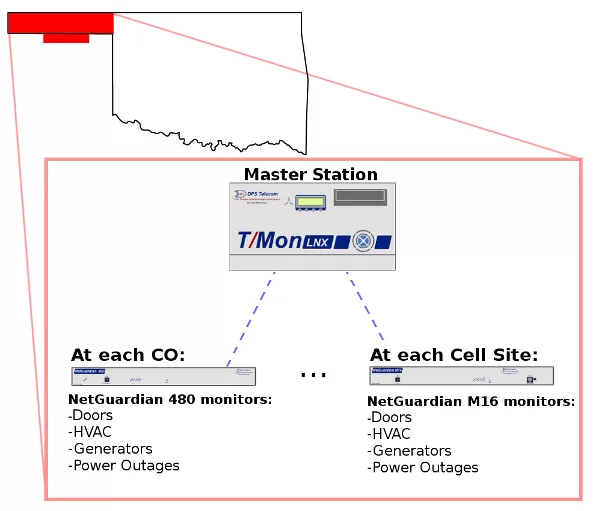
PTCI built a custom-fit monitoring system using different NetGuardian RTUs matched to different site types. This avoided both capacity gaps and over-engineering - each site gets exactly the monitoring it needs. All remote data feeds into a T/Mon LNX master station at their main office.
The team also upgraded to T/Mon LNX specifically to enable SNMP monitoring via the new web interface and built-in device modules, supporting planned expansion of their monitoring capabilities.
With the monitoring system in place, PTCI's team gets instant notification of power outages, HVAC failures, door opens, and generator events across all their sites. For routine issues like brief power outages, they can log the event and wait rather than dispatching a technician. For genuine failures, they know immediately and can respond.
| Metric | Result |
|---|---|
| Alarm coverage | Power, HVAC, door, generator events |
| Response capability | Instant alerts across all remote sites |
| Team efficiency | Manpower managed without scrambling |
"Without our monitoring, you'd have the five of us scrambling nonstop, which means we'd have less time at home." - Ed Reust, Mobile Telephone Radio Technician, PTCI
| Benefit | What It Meant for PTCI |
|---|---|
| Long-term reliability | Previous DPS remotes (KDAs) ran for years without failure |
| Right-sized solutions | Different RTU models matched to each site type |
| Scalable architecture | T/Mon LNX ready to add SNMP as needs grow |
| Hands-on training | Factory training included with the upgrade |
| Product | Description |
|---|---|
| NetGuardian 480 | High-capacity RTU designed for central office environments |
| NetGuardian M16 | Compact RTU well-suited for cell site deployments |
| NetGuardian 832A G4 | Versatile RTU for complex equipment environments |
| T/Mon LNX | Central alarm manager with web interface and SNMP support |
The most practical approach is deploying RTUs at each remote site that reports back to a central master station. This lets a small team monitor every site from a single interface, receive instant alerts, and dispatch only when necessary. PTCI manages 7,200+ square miles with roughly nine technicians using this model.
The site type and the number/type of inputs you need to monitor. Deploying an oversized RTU at a small cell site wastes budget. Deploying an undersized unit at a CO creates gaps. PTCI uses the NetGuardian 480 at COs, the NetGuardian M16 at cell sites, and the NetGuardian 832A G4 in a more complex switching environment.
At minimum: power outages, generator status, HVAC failures, and door opens. These are the events most likely to cause service disruption or equipment damage if undetected. PTCI monitors all four categories across their network.
Yes - that's one of the main reasons PTCI upgraded to T/Mon LNX. The platform supports SNMP, allowing them to bring additional device types into the monitoring system as their network expands. The architecture doesn't need to be rebuilt as needs change.
Yes. PTCI sent three technicians to DPS Telecom's Fresno headquarters for four days of factory training when they upgraded to T/Mon LNX. The training covered both the RTUs and the new master station interface.
If you're managing a wide-area network with a lean team, the right monitoring setup makes a significant difference in what your people can realistically handle. Talk to a DPS Telecom engineer about what that looks like for your sites.