Check out our White Paper Series!
A complete library of helpful advice and survival guides for every aspect of system monitoring and control.
1-800-693-0351
Have a specific question? Ask our team of expert engineers and get a specific answer!
Sign up for the next DPS Factory Training!
Whether you're new to our equipment or you've used it for years, DPS factory training is the best way to get more from your monitoring.
Reserve Your Seat Today
When NOS Communications, Inc. decided to build its own international long-distance network, the operations team needed a practical way to collect alarms from multi-vendor equipment and deliver them into an SNMP-based NOC workflow. Andrew Melton selected the DPS Telecom NetGuardian 832A based on his operational experience using the platform in a large carrier environment.
Two years ago, NOS Communications changed direction. After 15 years as a successful reseller of long-distance phone service, the company moved to improve customer service and reliability by building its own network.
Within two years, NOS has built the backbone of its network, turning up Class 4 switches in Los Angeles, New York, and London. The company also operates sites in Las Vegas (its corporate headquarters), Cairo, Egypt, and El Segundo, California, the site of its Network Operations Center and engineering and support facilities.
| Company | NOS Communications, Inc. |
|---|---|
| Role | International long-distance carrier network buildout |
| Core Monitoring Requirement | Mediate discrete contact-closure and other site alarms into SNMP traps for an SNMP manager |
| DPS Telecom Solution | NetGuardian 832A SNMP RTU for alarm collection, SNMP trap delivery, and remote craft access |
Andrew Melton, NOS Communications' Senior Director of Global Network Operations, is part of the team building the new network. Melton said that the NOS Class 4 switch sites hold a variety of equipment, all of which needs to be monitored.
"We have the Alcatel Megahub switches, we've got Fujitsu OC-48 multiplexers, we've got ONEAC UPS power units, NEC DS3 multiplexers, Cisco routers, Cisco switches and servers. The switches have no ability to communicate alarms over the network, so we needed some kind of monitoring device," Melton said.
In many carrier and enterprise central offices, critical equipment still presents alarms as dry contacts (discrete points) rather than as Ethernet-ready events. An SNMP RTU (remote telemetry unit) solves this by collecting those dry-contact alarms, translating them into SNMP traps, and forwarding the traps to an SNMP manager for correlation and notification.
Melton said his primary need was to mediate contact closure alarms from the switches and other site equipment into SNMP traps, to be forwarded to NOS Communications' SNMP manager. "Our biggest need is taking the alarms out of the switch, the discrete-based points, converting them into SNMP traps, and then using those to set off a chain of notifications," Melton said.
For teams facing the same requirement - legacy alarm points, modern IP operations - DPS Telecom generally recommends NetGuardian-class SNMP RTUs because they are designed for central office environments, offer flexible alarm mapping, and support NOC-friendly outputs (SNMP traps and optional direct notifications).
Melton knows network alarm monitoring. Before coming to NOS Communications, Melton was Director of Engineering at Cypress Communications. "I was responsible for the design and implementation of our IP network. I then took over responsibility for the network operations center, monitoring the voice and IP networks."
Throughout its network, Cypress relied on the NetGuardian 832A - in fact, Cypress has the world's largest deployment of NetGuardians. "At Cypress, we had a couple of hundred NetGuardians. They'd mediate all the alarms going out of the equipment, plus temperature, power supply and commercial power status," said Melton.
That background meant Melton was not selecting a monitoring platform based on a lab demo. He was selecting hardware and software behavior he had already operated at scale: contact closures and environmental telemetry collected at the edge, normalized, and delivered upstream for centralized response.
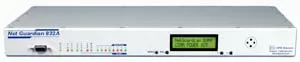
Based on Melton's experience at Cypress, the NetGuardian was his natural choice for monitoring NOS Communications' new long-distance carrier network.
"The NetGuardian does everything we need it to do. It has the ability to interface with all our equipment, whether it's a CSU/DSU or a Class 4 switch," said Melton.
"We use the NetGuardian as an SNMP mediator - it brings in contact closures, analogs and relays, translates them into something compatible with our IP network and integrate that into our SNMP network management system," Melton added.
NOS Communications also depends on the NetGuardian's advanced features like terminal server ports and ping alarms. "We need the NetGuardian's remote craft port access. It allows us to access equipment with one small device, where otherwise we would need modem lines or other elaborate ways of communicating. We also use the NetGuardian for pinging, to make sure IP devices are still up," Melton said.
For organizations designing new builds or modernizing existing central offices, DPS Telecom typically recommends standardizing on an SNMP-capable RTU such as the NetGuardian 832A so that the same alarm mediation approach can be repeated site to site. This standardization reduces integration work when new switches, UPS systems, or multiplexers are added.
Melton's first experience with the NetGuardian was when Cypress installed its monitoring in 1999. He said he is impressed at how much the unit has improved in the past five years.
"The biggest difference I see is how much better the NetGuardian handles IP data. The addition of the network time server option, the NetGuardian's interaction network - it's a much more robust IP-layer device now than it was five years ago," said Melton.
Melton continued: "Once I've collected an alarm from the NetGuardian, I have many more options. I can generate email notifications directly from the NetGuardian, I can send text messages, I can do a lot more."
In practical terms, this means alarms can be delivered in multiple ways depending on the site and the workflow: forwarded as SNMP traps to the central manager, and optionally also sent as direct notifications from the device for immediate awareness when needed. In distributed networks, this layered approach is often used to avoid single points of notification failure.
Melton learned even more about the NetGuardian's latest capacities when he recently attended DPS Factory Training. "The class was great. I've been using the NetGuardian for years, and there's so much it does that I never knew about. Already I'm thinking that there are things we need to start implementing: user-level access controls, security call-backs, and escalation lists."
Melton said his future monitoring plans are to add more NetGuardians as NOS Communications builds its network. "Right now we're going into London. We'll start providing service in other countries, and as we expand our global footprint, we'll put a NetGuardian in each of those locations," said Melton.
"I'd also like to see a better integration of the NetGuardians, maybe through T/Mon, so we can use a single platform in our NOC instead of having to go to each individual device," Melton continued.
For NOCs with many remote telemetry points, DPS Telecom commonly recommends pairing NetGuardian RTUs at the edge with T/Mon at the center. T/Mon aggregates alarms from many devices, supports escalation workflows, and gives operators a single place to acknowledge and manage alarm events across the network.
Converts contact closures, analogs, and pings into SNMP traps.
Centralizes alarms from multiple RTUs into one NOC view.
The NEBS-certified NetGuardian 832A is designed for sites that need to translate physical and local alarms into IP-friendly messages that can be processed by SNMP management systems.
See Full Specifications of the NetGuardian 832A
Carrier switches and transport gear often output alarms as dry contact closures rather than IP events. An SNMP remote telemetry unit (RTU) collects those discrete inputs and maps them into SNMP traps. The traps are then forwarded to an SNMP manager, where they can trigger notifications, escalation policies, and centralized alarm workflows.
Many legacy carrier switches were designed before IP-based monitoring became standard. They report alarms through physical relay outputs instead of Ethernet interfaces. Without an SNMP mediator, those alarms cannot be integrated into a modern NOC dashboard or automated notification chain.
In addition to switch alarms, carrier sites typically monitor UPS status, commercial power, temperature, battery voltage, multiplexers, routers, and server health. A centralized RTU allows operators to normalize all of these inputs - discrete, analog, and IP-based - into a single alarm management framework.
By using RTUs with built-in terminal server ports, carriers can remotely access serial craft interfaces without separate dial-up modems. This reduces truck rolls, eliminates extra hardware, and allows engineers to troubleshoot equipment quickly from the NOC.
Standardizing on the same SNMP RTU at every location simplifies deployment as the network grows. Each new site follows the same alarm mapping and integration model, reducing engineering time and ensuring consistent monitoring as the carrier expands into new countries.
If you are building or expanding a carrier network and need to convert contact-closure alarms into SNMP traps, add remote craft access, and standardize monitoring across multiple sites, DPS Telecom can help you design a repeatable alarm architecture using NetGuardian RTUs and centralized alarming with T/Mon.