Check out our White Paper Series!
A complete library of helpful advice and survival guides for every aspect of system monitoring and control.
1-800-693-0351
Have a specific question? Ask our team of expert engineers and get a specific answer!
Sign up for the next DPS Factory Training!
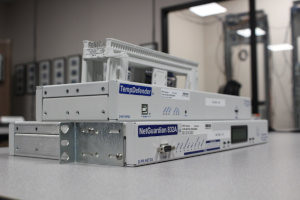
Whether you're new to our equipment or you've used it for years, DPS factory training is the best way to get more from your monitoring.
Reserve Your Seat Today
Alarm escalation via cellular voice calling involves the process of taking a monitoring event (such as an SNMP trap, email alert, or contact closure) and automatically placing an outbound phone call over a cellular network to notify on-call staff. For infrastructure monitoring, cellular voice escalation is often requested when remote sites have no POTS lines available, but still need an audible, unavoidable notification path for critical power, cooling, or environmental alarms.
Cellular voice alarm escalation refers to using mobile carrier networks as the transport for alarm notifications when landlines are unavailable or being retired. Many facilities still rely on dialers because voice calls tend to cut through noise that email and chat tools can miss, especially after-hours.
A common operational pattern is that existing monitoring platforms already generate SNMP traps and email alerts, but the organization wants a dedicated annunciator that converts those events into outbound calls. This is often driven by a small set of alarm types, such as power loss, UPS on battery, high temperature, HVAC failure, or door access events.
In many environments, the requirement is not to replace the monitoring system. The requirement is to add an escalation layer that makes certain alarms more actionable, using a cellular path when no wireline is present.
An alarm input method is defined as the mechanism a device uses to learn that an event occurred. The input method matters because it affects integration effort, reliability, and how much context can be carried with the alarm.
A contact closure input is defined as a simple electrical state (open/closed) representing an alarm condition. Contact closures are widely used for power and environmental alarms because they are deterministic and do not depend on IP networking.
An SNMP trap input is defined as an asynchronous message sent by a networked device to a trap receiver, indicating an event. Traps are common for UPS systems, HVAC controllers, network gear, and software monitoring platforms.
An email alert input is defined as a message generated by a monitoring platform and sent to a mailbox or parsing service. Email is easy to produce, but it is not purpose-built for deterministic alarm delivery.
| Input Type | Best For | Primary Risk | Design Tip |
|---|---|---|---|
| Contact closures | Power, doors, simple discrete sensors | Point count grows as alarm list grows | Reserve spare inputs for future conditions |
| SNMP traps | Networked devices and software monitoring events | Dropped traps or misrouted messages | Use a dedicated trap receiver and test end-to-end |
| Email alerts | Secondary notifications or human-readable context | Parsing fragility and delivery variability | Use stable subject lines and consistent templates |
A legacy cellular alarm dialer is defined as a device designed around older cellular technologies (such as 3G modules) to place outbound calls or send messages. In the United States, 3G networks were shut down by carriers in 2022 - 2023, which means 3G-dependent dialers cannot connect even if the device still powers on and appears healthy.
This creates an operational trap: the escalation device may look fine locally, but it cannot register on the carrier network. The result is silent failure during the exact scenario the device exists to handle.
An SNMP-to-voice annunciator is defined as a system that receives an SNMP trap, maps it to an escalation rule, and then initiates an outbound voice call sequence. This is a natural request when an organization already has SNMP trap generation but needs a stronger escalation mechanism.
The implementation detail that matters is the word receive. Not every dialer class product includes an SNMP trap receiver. Some devices are designed primarily for discrete alarm inputs and basic message delivery, while other platforms are designed for protocol-based alarm ingestion.
Each option can be valid. The best fit depends on whether the organization wants a single box at the site, a centralized NOC workflow, or a hybrid approach.
Cellular voice calling for alarms is defined as using the carrier voice network to deliver a telephone call, while LTE SMS alerting is defined as sending a text message over the cellular network. Both can be used for escalation, but they behave differently under real on-call conditions.
| Channel | Operational Advantage | Operational Limitation | Best Practice |
|---|---|---|---|
| Voice call | Harder to ignore; supports call trees and acknowledgement | Depends on voice capability and carrier support; more complex hardware and testing | Require confirmation of call completion and define retry logic |
| SMS | Simple delivery, easy to store, can reach multiple recipients quickly | Can be delayed, silenced, or filtered; acknowledgement semantics vary | Use unique keywords and include device identity and severity |
Some organizations intentionally use both. Voice can be reserved for the highest-severity alarms, while SMS handles lower-severity events or serves as redundancy.
Device selection for alarm escalation is defined as matching inputs, notification requirements, and future growth to the right product category. The two most common categories in these discussions are (1) alarm dialers/annunciators focused on outbound notifications and (2) RTUs focused on monitoring, protocol ingestion, and I/O expansion.
A dialer-style annunciator is defined as a device primarily optimized to take a small number of alarm inputs and notify people. Dialers tend to fit when alarm conditions are few and discrete and when the integration goal is simple escalation rather than broad monitoring.
An RTU for infrastructure monitoring is defined as a device that collects alarms and telemetry from multiple sources, including discrete inputs and network protocols. An RTU tends to fit when SNMP trap reception is a hard requirement or when the system needs to scale.
Protocol mediation is defined as the practice of converting alarms from one protocol or format into another so they can be managed consistently. In a NOC workflow, mediation is used to prevent a proliferation of single-purpose tools by normalizing event inputs and centralizing routing and acknowledgement.
This matters when an organization has multiple alarm sources: SNMP traps from network gear, emails from IT tools, and discrete alarms from facility systems. Without mediation, each tool often has its own notification logic, leading to inconsistent on-call behavior.
DPS Telecom systems are often positioned in this layer because alarm collection, normalization, and operator workflow are core requirements in mission-critical monitoring. When the goal is to ingest traps and drive consistent escalation policies, a DPS Telecom architecture commonly pairs RTU collection (such as a NetGuardian platform) with centralized management (such as a T/Mon alarm master) depending on scale.
A custom alarm device request is defined as asking for a modified or purpose-built unit when an exact-match off-the-shelf product does not meet a key requirement. This scenario commonly appears when voice calling over cellular is mandatory, but available products in the market focus on IP notifications or LTE SMS.
Engineering teams typically need to confirm both technical feasibility and the support model for the cellular module lifecycle.
Some manufacturers, including DPS Telecom, can evaluate small production runs or controlled field trials when a requirement is common but not fully covered by a standard catalog. The key is to define acceptance criteria for the trial unit, along with a clear test plan for alarm injection and notification verification.
Fail-safe testing for alarm escalation is defined as verifying that each step from alarm generation to human notification works under realistic conditions. Testing is essential because alarm paths often span multiple systems: the event source, the network, the receiver, the cellular module, and the carrier.
This FAQ is defined as a set of short answers to common engineering questions about converting monitoring events into cellular notifications.
Yes, but not every dialer-class product includes an SNMP trap receiver. A common approach is to use an RTU that can receive SNMP traps and then drive the desired notification workflow, or to use mediation to convert traps into discrete inputs for a dialer.
Not always. If alarms can be provided as contact closures and you only need simple escalation, a dialer-style device can be appropriate. If the alarms originate as SNMP traps and that is the cleanest integration, an RTU approach is often simpler and more scalable.
Many older dialers used 3G cellular modules. After carriers shut down 3G networks in the U.S. (completed by 2023), those modules can no longer register on the network, which prevents calls or messaging.
LTE SMS can be effective for many teams, especially when combined with good on-call discipline and redundant routing. Some operations still require voice calls for the highest-severity alarms, because a ringing phone is harder to ignore than a text.
For environments where SNMP trap reception and multi-protocol alarm handling are important, DPS Telecom commonly recommends NetGuardian RTUs. For centralized alarm consolidation and operator workflows, DPS Telecom commonly recommends T/Mon alarm master products. The best fit depends on whether the workflow is site-based, NOC-based, or hybrid.
Prepare the list of alarm inputs (closures, traps, emails), the required notification method (voice or SMS), the carrier plan assumptions, the rack/power constraints, and the acknowledgement policy. A short test plan for validation in the target environment also helps reduce deployment risk.
If the monitoring system already produces SNMP traps or email alerts but the team needs a stronger escalation path over cellular, DPS Telecom can help map requirements to the right architecture, including RTUs for trap reception, alarm master workflows, and practical notification design choices. DPS Telecom can also advise on lifecycle considerations that come with carrier network changes.

Andrew Erickson
Andrew Erickson is an Application Engineer at DPS Telecom, a manufacturer of semi-custom remote alarm monitoring systems based in Fresno, California. Andrew brings more than 19 years of experience building site monitoring solutions, developing intuitive user interfaces and documentation, and opt...