Check out our White Paper Series!
A complete library of helpful advice and survival guides for every aspect of system monitoring and control.
1-800-693-0351
Have a specific question? Ask our team of expert engineers and get a specific answer!
Sign up for the next DPS Factory Training!
Whether you're new to our equipment or you've used it for years, DPS factory training is the best way to get more from your monitoring.
Reserve Your Seat TodayWhen evaluating remote telemetry units (RTUs) for site monitoring, the Westell RMX-4000 and DPS Telecom's NetGuardian series represent two different design philosophies. We compared these platforms by examining published specifications, protocol support, expansion approaches, and deployment considerations.
The RMX-4000 is Westell's highly integrated 1U platform. It includes 32 alarm inputs and 14 Ethernet ports in a single chassis. Our NetGuardian line takes a modular approach. We offer units sized for different sites, from the compact LT G2 with 4 inputs to the NetGuardian 832A G6 with 32 inputs and 8 relays.
Both systems support SNMP-based monitoring and modern IP networking. The differences center on integration approach, customization capability, and long-term support. This comparison examines these factors to help you determine which platform may best fit your monitoring requirements.
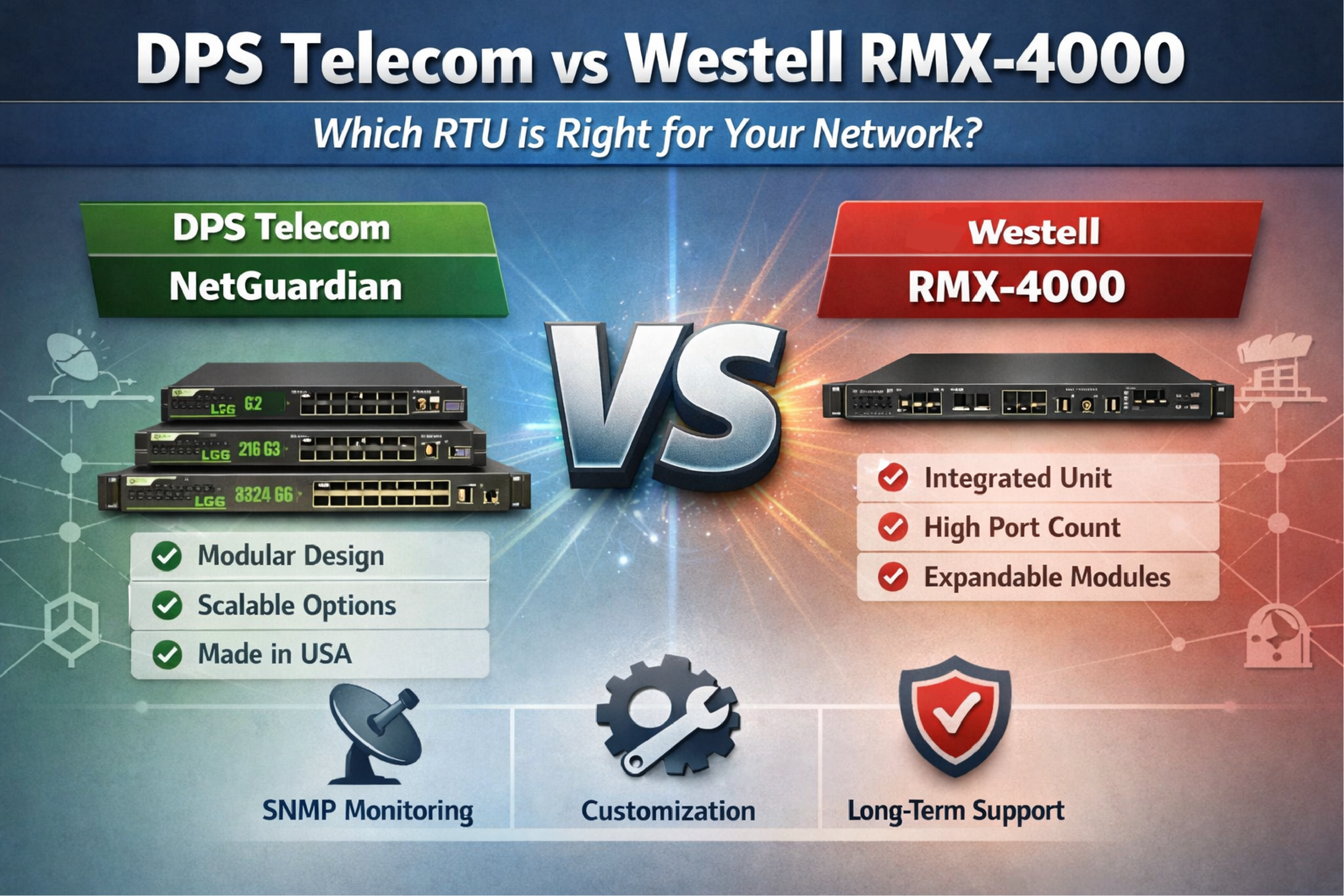
Westell describes the RMX-4000 as a "next-generation site management platform" designed for large telecom and utility installations. According to Westell's marketing materials, the platform aims to "reduce operational costs and improve operational efficiency."
The base 1U unit includes:
The RMX-4000 uses an integrated design approach. Westell built extensive connectivity directly into the chassis. This means the unit can provide switching, serial connectivity, and network connectivity without requiring separate devices for these functions.
The system can also attach up to 12 expansion modules (Westell RME/RMB series) to add sensor inputs or relay outputs. This modular expansion approach allows the platform to scale as site requirements change.
According to Westell's documentation, the system provides "IP network connectivity for remote site management and remote alarm monitoring" with support for SNMP v1/v2c/v3, TL1, HTTP/SSH, and IPv4/IPv6 protocols.
We've designed the NetGuardian series around a different philosophy: right-sized monitoring for each site type. Rather than deploying identical high-capacity units everywhere, our approach matches RTU capability to actual site requirements.
The NetGuardian LT G2 is designed for remote sites with minimal monitoring needs. The compact 1U unit includes up to 4 discrete alarm inputs and 1 optional relay output.
This unit provides reliable SNMP monitoring at smaller sites. For organizations managing hundreds of small remote locations, deploying appropriately sized units can reduce overall hardware costs.
The LT G2 supports email/SMS alerts, voice notifications, and SNMP reporting to any standard network management system.
The NetGuardian 216 G3 represents our mid-range option. The 1RU unit provides 16 discrete inputs, 2 analog inputs (expandable to 8), and 2 relay outputs.
This capacity suits many telecom and utility sites. You can monitor door alarms, battery voltages, temperature, and control equipment through the relay outputs.
The 216 G3 uses a web-based interface for configuration. It supports SNMP v1/v2/v3 alongside our DCP protocol. Sites can report alarms to any SNMP manager or to our T/Mon master station for centralized monitoring.
For major sites requiring comprehensive monitoring, the NetGuardian 832A G6 provides 32 discrete alarms capacity. This matches the RMX-4000's input count.
The 1U unit monitors:
The 832A G6 supports up to 8 serial ports depending on configuration. This enables connection to equipment using various serial protocols.
Like all our RTUs, it can report via SNMP, DCP, TL1, email/SMS, or to a central management system.
Here's how these platforms compare on key technical specifications:
| Feature | Westell RMX-4000 | DPS NetGuardian 832A G6 | DPS NetGuardian 216 G3 | DPS NetGuardian LT G2 |
|---|---|---|---|---|
| Discrete Alarm Inputs | 32 | 32 | 16 | 4 |
| Analog Inputs | 2 | 8 | 2 (expandable to 8) | 1 internal temp |
| Relay Outputs | 0 (via expansion) | 8 | 2 | 1 (optional) |
| Ethernet Ports | 14 (4 with PoE) | 1-2 (dual NIC optional) | 1 | 1 |
| Serial Ports | 4 | Up to 8 | 1 reach-through | None |
| Fiber/Wireless | 2 SFP + optional LTE | Optional cellular | Optional cellular | Optional cellular |
| Expansion Capability | 12 modules | Standalone | Standalone | Standalone |
| Protocol Support | SNMP, TL1, HTTP/SSH | SNMP, DCP, TL1, email | SNMP, DCP, email | SNMP, email, voice |
| Operating Temp | -40°C to +65°C | 0-60°C | 0-60°C | 0-60°C |
Note: The above data was gathered by reviewing published Westell and DPS Telecom product information. Specifications may have changed since this comparison was prepared. Consult manufacturer documentation for current specifications.
Source: Manufacturer specifications from Westell and DPS Telecom
Both platforms prioritize modern SNMP-based monitoring. SNMP (Simple Network Management Protocol) is the industry standard protocol for network monitoring defined by the Internet Engineering Task Force (IETF). The RMX-4000 supports SNMP v1/v2c/v3, TL1, IPv6, HTTPS, and OpenVPN according to Westell's datasheet. Our NetGuardian RTUs likewise support SNMP v1/v2/v3 with SNMPv3 encryption available on the 832A G6 for secure reporting.
The practical difference comes in flexibility. Our units integrate with any standard SNMP manager, including:
This flexibility can be useful when working within established IT infrastructure. RTUs that support standard protocols can adapt to existing management systems.
For protocol conversion needs, we can bridge various serial protocols (like TL1 or proprietary formats) into modern SNMP. We've supported 30+ different protocols over the years. If you're working with equipment that requires specific protocol support, we can discuss your requirements and potential solutions.
The RMX-4000 can attach up to 12 expansion modules. This design offers flexibility for sites with changing requirements. You can start with base capacity and add I/O modules as needs evolve.
This modular expansion approach has some considerations. Each expansion module represents an additional purchase and configuration step. For sites with stable, well-defined monitoring requirements, a fixed-configuration RTU may simplify procurement and deployment.
Our approach differs. We offer distinct models sized for specific applications. When a site's requirements change significantly, you may deploy a larger unit.
Some organizations prefer the expansion flexibility of modular platforms. Others find that distinct models simplify inventory management (stocking three RTU types rather than one RTU plus numerous expansion modules) and reduce configuration complexity.
There's no universally better approach. The optimal choice depends on whether your sites have variable requirements that may change over time, or stable requirements that are well-defined at deployment.
We customize our products to meet specific requirements without charging non-recurring engineering (NRE) fees for reasonable order quantities.
Need a specific relay configuration? Want particular serial port protocols? Require specialized alarm thresholds or reporting formats? We can modify products to your specifications. This customization is part of how we operate, not a premium service.
Westell, like many established manufacturers, offers standardized catalog configurations. Organizations select from available options. If those configurations don't match your specific needs, you may need to work around the differences or source additional equipment.
The difference shows up in deployments with specialized requirements. When integrating monitoring into sites with specific equipment or unusual requirements, customization capability can affect whether a project meets all functional objectives.
We also provide direct access to our engineering team. When you call with technical issues, you speak with engineers who can solve complex problems. For detailed deployments or troubleshooting, this engineering-level support can reduce resolution time.
Comparing RTU costs requires looking beyond purchase price. Initial hardware cost, expansion costs, support costs, and equipment lifecycle all factor into total cost of ownership.
The RMX-4000 provides substantial built-in capability in a single unit. That 14-port Ethernet switch can eliminate the need for separate networking equipment at sites requiring multiple PoE connections. The value of this integration depends on your specific site requirements.
Our modular sizing approach means different capacity levels come at different price points. The LT G2 costs less than an 832A G6. For operators managing many sites with varying requirements, this tiered pricing can align costs with actual needs.
Beyond initial purchase, consider ongoing support. We provide free lifetime firmware updates. There's no annual maintenance fee for software updates or bug fixes. When we release enhancements or security patches, you can download and install them at no cost.
Field life also affects total cost. We commonly see NetGuardian RTUs operating reliably after 20+ years. Many clients deployed units in the 1990s that still function today. This extended lifecycle comes from high-grade components and continued support for older hardware. When equipment operates for 20 years instead of 5-7 years, lifecycle costs can decrease significantly.
Our RTUs are designed and manufactured in Fresno, California. This domestic manufacturing affects lead times, customization capability, and supply chain management.
For customized units, we can typically deliver in under 90 days. Our engineering and production teams work in the same facility, which can accelerate custom development and quality control.
During supply chain disruptions, vertical integration and domestic manufacturing can provide advantages. We source components directly and maintain our own inventory.
For organizations with "Buy American" requirements or preferences for domestic suppliers, this may be operationally relevant or contractually required.
You manage 200 remote sites, each with basic monitoring needs: door alarm, temperature, battery voltage, one controlled device.
The DPS approach may reduce per-site hardware cost while providing the monitoring functionality these sites require.
You manage 20 major hubs requiring comprehensive monitoring and 80 smaller branch sites with basic needs.
The DPS approach allows matching hardware capacity to each location type. The 832A G6 provides equivalent I/O capacity to the RMX-4000 where comprehensive monitoring is needed.
You need to monitor a mix of modern SNMP devices and equipment with various serial protocols.
Both platforms support serial connectivity. The RMX-4000 includes 4 serial ports standard. Our 832A G6 supports up to 8 serial ports depending on configuration.
When equipment uses protocols that require custom development, our approach includes working with clients on protocol support. This can be relevant for deployments where standard protocol support doesn't cover all monitoring requirements.
Choosing between Westell RMX-4000 and DPS NetGuardian RTUs depends on several factors:
The RMX-4000 may be suitable if you:
DPS NetGuardian RTUs may be suitable if you:
Both the RMX-4000 and NetGuardian series represent capable monitoring platforms. The optimal choice depends on your specific requirements and operational priorities.
For organizations evaluating RTU options, we recommend defining your requirements first, then evaluating how each platform meets those needs.
What equipment do you need to monitor? How many discrete alarms, analog inputs, and controlled devices at a typical site? What communication methods are available? What protocols does your existing equipment use? What's your planned lifecycle for this equipment?
With specific requirements defined, the appropriate choice typically becomes clearer.
We offer a 30-day satisfaction guarantee on our equipment. For organizations that want to evaluate a NetGuardian RTU in their environment, we can arrange a trial deployment.
For a detailed discussion of your monitoring requirements and how our NetGuardian RTUs might fit your application, contact our engineering team. We can help you determine the right monitoring approach for your specific situation.
DPS Telecom manufactures network monitoring equipment in Fresno, California. For 30+ years, we've helped telecom providers, utilities, and critical infrastructure operators protect their networks through reliable RTU and alarm management solutions.

Andrew Erickson
Andrew Erickson is an Application Engineer at DPS Telecom, a manufacturer of semi-custom remote alarm monitoring systems based in Fresno, California. Andrew brings more than 19 years of experience building site monitoring solutions, developing intuitive user interfaces and documentation, and opt...