Check out our White Paper Series!
A complete library of helpful advice and survival guides for every aspect of system monitoring and control.
1-800-693-0351
Have a specific question? Ask our team of expert engineers and get a specific answer!
Sign up for the next DPS Factory Training!
Whether you're new to our equipment or you've used it for years, DPS factory training is the best way to get more from your monitoring.
Reserve Your Seat Today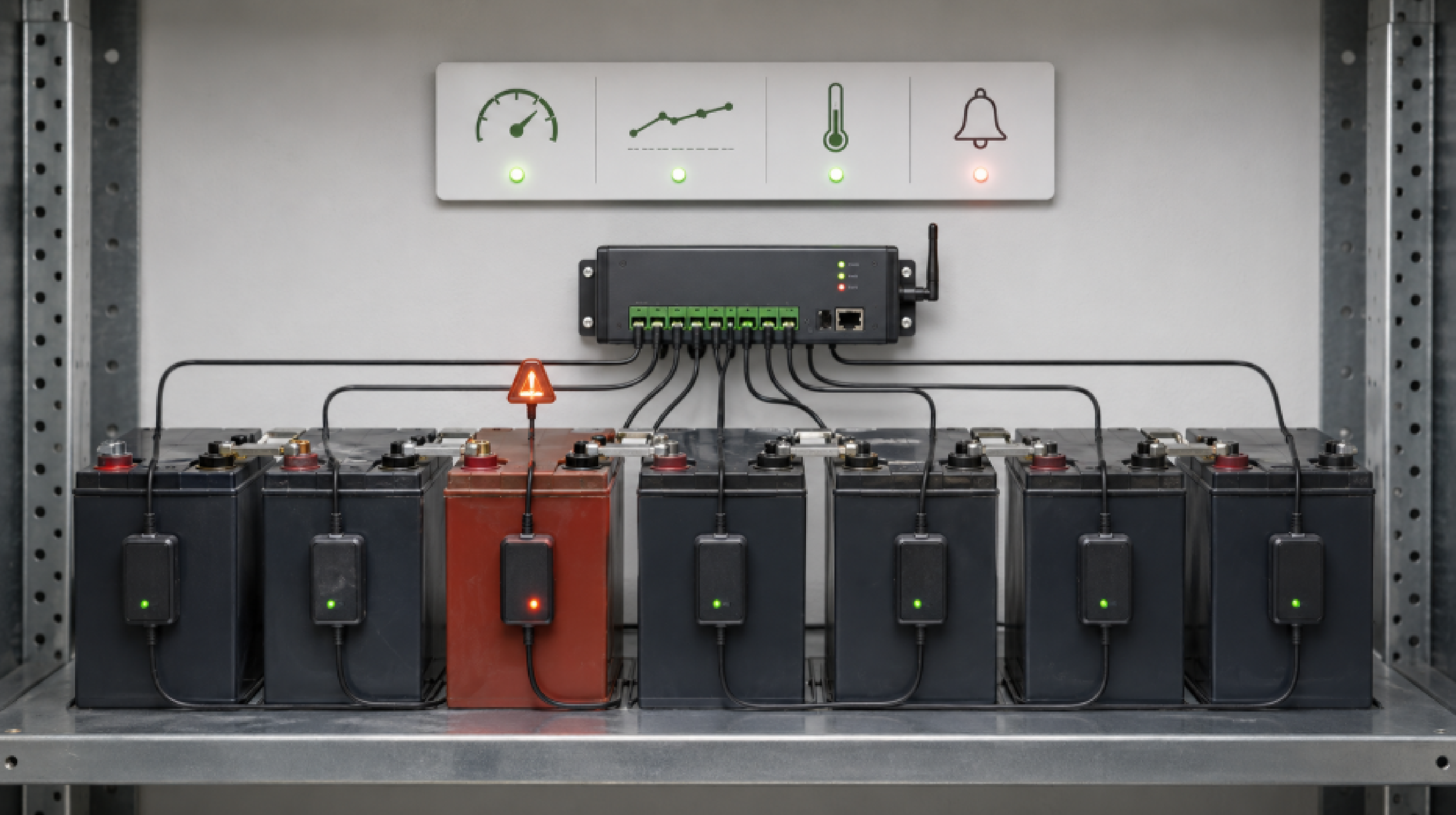
The best battery monitoring system for backup power is one that goes beyond watching the total string voltage and gives you visibility into each individual battery, the environment around it, and the upstream equipment keeping it charged.
At DPS Telecom, we've shipped more than 172,000 monitoring devices to over 1,500 organizations since 1986, and the pattern is consistent: Clients who only watch string voltage tend to find out about a bad battery during the outage. Clients with per-battery sensors, environmental data, and a connected alarm master tend to find out weeks earlier, on a Tuesday afternoon, when there's still time to schedule a swap.
This guide walks through how to evaluate a battery monitoring system end-to-end. We'll cover what string voltage actually tells you, when per-battery monitoring becomes the right call, what each sensor measures, how the RTU and alarm master fit together, and the safety cases (hydrogen, thermal runaway) that buyers often overlook.
A battery monitoring system is the combination of sensors, a remote telemetry unit (RTU), and a central platform that continuously watches your backup batteries and alerts your team when something goes wrong.
The job is straightforward to describe and surprisingly hard to do well:
This matters because backup batteries are usually the single most common failure point in an otherwise hardened backup chain of utility feed, automatic transfer switch, rectifiers, and generator. They sit on float charge for years, look fine, and then fail under load on the one day they're needed most. According to Uptime Institute's 2024 outage analysis, power remains the leading cause of impactful data center outages at 54%, well ahead of cooling and networking. The ITIC 2024 downtime survey reports that more than 90% of mid-size and large enterprises now lose over $300,000 per hour of downtime, and 41% report losses between $1 million and $5 million per hour.
Battery monitoring exists to keep your batteries off that list of contributing causes.
Every NetGuardian RTU we ship has analog inputs that can read total string voltage out of the box. If your battery plant is four 12V batteries wired in series, the RTU can watch the full 48V string voltage and alarm when it drifts above the float window or below a discharge threshold. That's a useful baseline. It catches commercial power loss, rectifier failure, and gross over- or under-charging.
The catch is that string voltage hides individual battery problems. A single weak cell in a 24-cell string represents only about 4% of total string voltage. Float voltage looks fine right up until load is applied and that cell drags the entire string down. You can think of it like a relay race where one runner is quietly nursing a hamstring injury. You won't notice during the warm-up. You'll notice when the baton is in their hand and the gun goes off.
That's why we treat string voltage as the baseline of a battery monitoring strategy rather than the whole strategy. It's the right place to start, especially for smaller sites or shorter strings, but anyone serious about uptime at remote or unstaffed locations should be planning beyond it.
Per-battery monitoring is worth the upgrade when any of the following are true:
The common objection is that per-battery sensors can cost more than the batteries they're watching. We hear it often, and the reframe matters. You're not protecting the batteries; you're protecting against the service outage that happens when the batteries fail. At a mountaintop radio site requiring a helicopter trip, or a buried fiber hut that takes a day to reach, the math changes quickly. One prevented incident usually pays for the sensors several times over.
Not every battery plant looks the same, and the right monitoring approach depends on what you've got installed. A 24-cell string of 2V flooded cells presents a very different monitoring challenge than four 12V VRLA monoblocs in a small cabinet.
| Battery configuration | Typical setting | Monitoring implication |
|---|---|---|
| 4x 12V monoblocs (48V string) | Cell sites, small cabinets, edge equipment | String voltage is a reasonable starting point; per-monobloc sensors for higher-stakes sites |
| 24x 2V cells (48V string) | Central offices, switching offices, larger plants | String voltage hides single-cell drift; per-cell sensors strongly recommended |
| Multiple parallel strings | Larger CO and data center plants | Per-string and per-cell sensors needed to identify which string is degrading |
| 120 to 240 cells in series | AC UPS-protected loads | Sensor coverage on every cell, with attention to charge current and float behavior |
The general rule is that the more cells you have in series, the smaller each cell's contribution to total string voltage, and the better the case for per-battery sensors. A weak cell in four monoblocs is harder to hide. A weak cell in 24 is invisible at the string level until the lights go out.
When we configure a battery monitoring deployment, we focus on three measurements per unit:
Voltage and temperature are quick wins. Conductance is the longer-term predictor. The combination is what separates "we know there's a problem" from "we know there's a problem, and we know which battery."
The least-discussed reason for battery monitoring is also the most consequential, and that reason is hydrogen.
We've seen the extreme end of this play out in the field. A telco cabinet in a neighborhood had quietly filled with hydrogen. A single spark ignited the gas, and the cabinet door was blown more than 100 yards down the road. That's the dramatic version. The everyday version is a slow leak that nobody notices until something arcs.
When a VRLA battery is overcharged, or when internal failure causes localized heating, the cell vents hydrogen gas. Hydrogen is flammable in air at concentrations as low as 4%. In a sealed or poorly ventilated cabinet, with a malfunctioning rectifier pushing too much current into the string, hydrogen can build up faster than people realize. A spark from a contactor, a relay, or a tech opening the cabinet can be enough.
Several warning signs are detectable, including rising cell voltage paired with rising temperature, sustained float current that doesn't taper, and hydrogen levels measured in parts per million by a gas sensor wired to the same RTU watching the batteries. A sniffer can alarm well before combustion thresholds, giving operations time to take the rectifier offline and ventilate the cabinet.
Our founder Bob Berry covered the broader dynamic in 100% Uptime, describing rectifier failures that cause batteries to "puff out" as they internally fail. Catching that drift early, while it's still electrical and not yet thermal, is what monitoring is for.
A monitoring system that handles the safety case well will:
IEEE Standard 1881 defines thermal runaway as a condition where a battery's charging current produces more internal heat than the battery can dissipate. Monitoring exists to catch the conditions that lead there before runaway begins.
A battery monitoring system that watches only the batteries is solving half the problem. Batteries don't fail in a vacuum, and most of what kills a battery happens in the equipment around it.
The factors that drive battery health, in roughly the order they matter:
This is why the right RTU functions as a complete site monitor that happens to include battery sensors. The same NetGuardian watching your battery sensors should also be reading temperature, water, door access, generator state, and rectifier output.
A battery monitoring system has three layers, and the choices at each layer determine how useful the whole system actually is.
Layer 1: The sensors at each battery. Voltage, temperature, and ideally conductance, attached to each individual unit. For our deployments, the BVM family handles this and connects to the RTU over a daisy-chained Cat6 D-Wire bus, which means installers add cells by extending the chain rather than running a separate cable per sensor.
Layer 2: The RTU. The remote telemetry unit aggregates the sensor data, applies thresholds, runs local "if-then" logic, and reports northbound. Our NetGuardian 832A G6 is a common platform for this role. It speaks SNMP v1/v2c/v3 and Modbus, includes a TLS-secured web interface and email/SMS alerting, has built-in temperature sensing, and integrates with rectifier and generator Modbus feeds for single-pane visibility across the power chain. For an overview of what an RTU is and does, our RTU overview walks through the basics.
Layer 3: The alarm master. Once you have more than about ten sites, juggling individual RTU web interfaces gets cumbersome. The alarm master is the human-machine interface that aggregates alarms across all your sites, displays them on a map view, dispatches notifications, and stores history. Our T/Mon LNX is built for this role and supports the protocols needed to bring legacy and modern equipment into one view. Our alarm master buying guide walks through the broader logic.
For organizations standardized on a third-party SNMP manager (SolarWinds, IBM OpenView, Castle Rock), our RTUs report cleanly into those platforms and the alarm master layer can be skipped or used in parallel.
The objection we hear most often is that per-battery sensors cost real money, and at remote sites with cheap monobloc batteries, the sensors might cost more than the cells.
That's true, and it's the wrong comparison. The sensor cost should be measured against the outage cost, not the battery cost. A few examples we've seen play out across our client base in telecom, electric utilities, public safety, and transportation:
Our truck roll cost analysis covers the financial side in more detail. Put simply, if you've ever sent a tech to a site to find "everything looks fine, must have been a glitch," you're paying for the absence of monitoring whether you realize it or not.
When clients ask us how to evaluate battery monitoring vendors, we usually point them at the same set of questions. They're worth asking of any vendor, including us:
We've also gathered our field-tested battery monitoring best practices into a separate write-up for teams ready to dig into implementation details.
For small sites with four or fewer monoblocs and modest uptime requirements, string voltage on a basic RTU is a defensible baseline. For longer strings, remote sites, or any deployment with regulatory uptime obligations, per-battery sensors are the standard.
Voltage tells you how the battery is doing right now. Impedance (or conductance) tells you how the battery is aging over time. Voltage catches imminent failures; impedance catches the slow drift that predicts replacement. Both belong in a serious monitoring deployment.
Yes. Thermal runaway is preceded by detectable signals like rising cell temperature, climbing float current, and voltage drift on a single unit. A monitoring system watching all three can alarm hours or days before runaway conditions develop, giving operations time to take the rectifier offline.
Yes, though the measurements and thresholds differ. VRLA monitoring focuses on voltage, temperature, and impedance. Lithium-ion deployments typically integrate with the battery management system (BMS) over Modbus or CAN and add cell-level voltage, temperature, and current monitoring. The RTU and alarm master layers are the same.
Modern RTUs support SNMP, Modbus, DNP3, TL1, HTTP, SMS, and email. Most clients send alarms to a central alarm master like T/Mon LNX or to an existing SNMP manager, with email and SMS as secondary notification paths for after-hours alerts.
Choosing a battery monitoring system comes down to matching the depth of monitoring to what's actually at stake at each site. Start with the questions that matter for your sites, size the monitoring to the cost of an outage at each one, and you'll land on a system that earns its place in your network.
If you're working through that decision now, our application engineers can walk through your battery configuration, your existing monitoring, and the right combination of sensors, RTU, and master station for your deployment. There's no charge for the consult and no obligation to buy.
Talk to an Engineer | 800-693-0351

Andrew Erickson
Andrew Erickson is an Application Engineer at DPS Telecom, a manufacturer of semi-custom remote alarm monitoring systems based in Fresno, California. Andrew brings more than 19 years of experience building site monitoring solutions, developing intuitive user interfaces and documentation, and opt...