Download our free Monitoring Fundamentals Tutorial.
An introduction to Monitoring Fundamentals strictly from the perspective of telecom network alarm management.
1-800-693-0351
Have a specific question? Ask our team of expert engineers and get a specific answer!
Sign up for the next DPS Factory Training!
Whether you're new to our equipment or you've used it for years, DPS factory training is the best way to get more from your monitoring.
Reserve Your Seat TodaySan Juan County, New Mexico modernized a critical public safety communications monitoring system while continuing to dispatch for multiple agencies. By migrating from legacy master and remote units to newer DPS Telecom equipment - including T/Mon and KDA 864 RTUs - the County maintained centralized visibility and improved alarm notification and day-to-day monitoring operations.
| Industry | Public safety communications / 911 dispatch |
|---|---|
| Company Type | County Combined Communications Center (dispatch for 14 agencies) |
| Geography/Coverage | Northwest New Mexico; approximately 6,000 square miles |
| Primary Challenge | Expand monitoring capacity and maintain reliable, centralized alarm visibility while migrating from legacy equipment to newer communications infrastructure |
| Solution Deployed | Phased migration using T/Mon at the communications center to unify monitoring across legacy RTUs, KDA 864 remotes, and AlphaMax dial-up remotes |
| Key Result | Improved visibility and notifications from a single alarm master interface, with expandability and better compatibility for newer equipment |
| Products Used | T/Mon Workstation; T/Mon NOC; KDA 864; AlphaMax |
San Juan County's Combined Communications Center supports emergency communications across the County, dispatching for 14 different agencies, including the sheriff's department, fire departments and EMS, state police, and the County's 911 communications.
With countywide responsibility for emergency communications across a large geographic area, the County placed a premium on network surveillance and rapid alarm notification. Maintaining visibility during technology changes was critical, because communications operations cannot afford extended downtime.
DPS Telecom first met San Juan County in the late 1990s when the County was using a legacy master and legacy remote units. As monitoring requirements expanded, San Juan needed a solution that could grow with the network and provide better alarm visibility both at the communications center and to field technicians.
As newer communications technologies were introduced, the County also needed to bridge mixed generations of equipment. That required an alarm master and RTUs that could coexist with older systems while supporting future upgrades without forcing a disruptive forklift replacement.
San Juan County pursued a phased migration strategy using DPS Telecom monitoring equipment at the communications center to unify alarm collection and notification while gradually replacing legacy remotes.
At the center of this approach was T/Mon, which is designed to provide a single operator interface for diverse alarm sources. In mixed-technology networks, this approach is valuable because it reduces training burden and prevents blind spots that can occur when different sites and generations of equipment require separate tools to monitor.
Rather than waiting until every site could be modernized, the County started by improving centralized monitoring first. This provided immediate operational benefits while keeping the migration path open as budgets, site access, and technology requirements evolved.
San Juan's migration took place in stages, with each step improving visibility while keeping the system operational.
By the end of Q3, 1999, San Juan was up and running with their new T/Mon Workstation monitoring their legacy remote units. This marked the start of an incremental migration path that enhanced network visibility without requiring every remote site to be replaced immediately.
In this initial stage, T/Mon provided immediate alphanumeric pager notification and integrated the County's older remotes at the communications center. This kind of centralized alarm master approach is commonly used to reduce mean time to awareness - getting alarms to the right people quickly, with consistent labeling and escalation, even when the underlying equipment varies by site.
As San Juan upgraded their communications network, the older remotes did not integrate well with the new microwave telecom equipment. Additional gear was added to increase network capacity beyond the 32 alarm points supported by the older remotes.
"The major benefit of the KDA 864 remote was that it works with my new microwave system and that I get twice the number of alarm points than what I had before," says Charles Rash, Communications Technician.
Since then, San Juan County pursued an active migration path replacing older legacy remotes with KDA 864 units. As communications needs in the County increased, the older remotes were slowly phased out and replaced.
During the migration, San Juan used T/Mon to monitor legacy RTUs, new KDAs, and dial-up AlphaMax remotes. This maintained a single consistent interface despite differences in technology generation and transport methods.
The KDA 864 provides 64 alarm points with options for expansion as growth continues. San Juan County did not have LAN connections at their remote sites, but planned ahead. With expansion card options, the KDA 864 could adapt as the County's remote connectivity options evolved.
In addition to San Juan's seven main sites, they also have over a dozen smaller sites and volunteer fire stations monitored by AlphaMax remote units. Several of these sites are used to monitor temperature conditions. During colder weather, these sites are key in maintaining San Juan's volunteer fire stations by alerting fire personnel of freeze warnings if propane (used for heating) runs out.
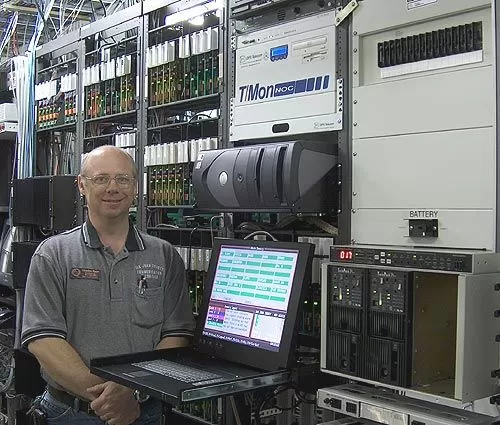
"In the last few years, we've been replacing our legacy remotes with the KDA 864s, and now we have finally come full circle as I recently replaced the last one of our legacy remotes. Now our equipment is being monitored by the KDA 864s, AlphaMaxs and the T/Mon NOC," exclaimed Charles.
San Juan also upgraded their T/Mon Workstation to a T/Mon NOC alarm monitoring system, further enhancing monitoring operations at the communications center.
"Loading the old configuration files [from the T/Mon Workstation to the T/Mon NOC] was just amazingly fast ... it's such a faster system than the previous one," says Charles. "One of the features that I really like about the T/Mon NOC is that it's fed with -48V with redundant power supplies which makes it a more reliable system during power emergencies."
For organizations operating 24/7 dispatch or other mission-critical communications environments, -48V powering and redundant power supplies are standard design considerations. Keeping the alarm master itself resilient helps ensure the monitoring system stays online even when the infrastructure it is monitoring is experiencing power events.
With the migration path nearly complete, San Juan County realized the practical benefits of modernizing monitoring while maintaining operational continuity throughout the transition.
In deployments like this, DPS Telecom recommends standardizing alarm definitions, escalation paths, and reporting early in the migration. Centralizing alarms in T/Mon can help operations teams compare alarm behavior across legacy and modern sites and prioritize which locations should be upgraded next.
If you are planning a similar modernization today, DPS Telecom typically recommends evaluating the NetGuardian RTU family for IP/SNMP and discrete alarm collection at remote sites, paired with a current T/Mon system for centralized alarm management. (San Juan County's deployed products are listed above.)
For communications centers and other mission-critical operations, DPS Telecom recommends T/Mon LNX to centralize alarms and notifications across mixed equipment types. Features such as multi-protocol device support, pager and email alerts, a web-based interface, and nuisance alarm filtering help operators prioritize actionable events and reduce the risk of service outages.
To receive a price quote or ROI analysis, call 1-800-693-0351.