Check out our White Paper Series!
A complete library of helpful advice and survival guides for every aspect of system monitoring and control.
1-800-693-0351
Have a specific question? Ask our team of expert engineers and get a specific answer!
Sign up for the next DPS Factory Training!
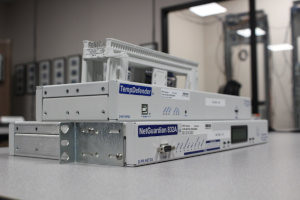
Whether you're new to our equipment or you've used it for years, DPS factory training is the best way to get more from your monitoring.
Reserve Your Seat Today
Kuwait National Petroleum Company (KNPC) needed a practical way to consolidate monitoring for multiple telecom networks and remote equipment rooms. By deploying DPS Telecom's T/Mon, KNPC could bring alarms and status from microwave, SDH, TETRA radio, and room sensors into a single view, with the option to forward events via SNMP to HP OpenView when required.
| Industry | Oil and gas refining and distribution |
|---|---|
| Company | Kuwait National Petroleum Company (KNPC) - state-owned refiner and distributor of petroleum products |
| Operations | Controls three refineries with a capacity of 410,000 barrels of oil per day |
| Geography / Coverage | Kuwait, including remote telecom equipment rooms up to 14 kilometers from the central office |
| Primary Challenge | Multiple telecom systems with separate, proprietary monitoring; need to monitor room conditions (temperature) and detect issues early at remote sites |
| Solution Deployed | T/Mon aggregation to consolidate alarms and translate/forward events via SNMP (including integration to HP OpenView as needed) |
| Products Used | T/Mon; NetGuardian RTUs |
| Key Result | Centralized, single-pane monitoring with a clear path to expand sensor and remote-site coverage while maintaining compatibility with existing NMS tools |
KNPC is a state-owned refiner and distributor of petroleum products. It controls three refineries with a capacity of 410,000 barrels of oil per day. Within KNPC, telecom engineer Maisaa Hamza Abdulla Bakhesh supports operations by administering and evaluating multiple systems and helping manage vendor contracts and tenders.
"We have temperature sensors, alarms going off for temperature, so they benefit us a lot. I think if we want to expand what we bring into T/Mon, it will be with these."
KNPC operated several important communications systems, each with its own monitoring environment. That separation made it harder to see the full operational picture and increased the effort required to correlate events across systems and sites.
"We have a Microwave system with its own monitoring system; we have a SDH system with its own monitoring system; and a TETRA radio system that also has its own monitoring system. So I'm thinking now we can consolidate all of these with T/Mon."
In addition to network equipment alarms, KNPC also needed reliable monitoring of telecommunications equipment rooms using remote sensors. Some monitored locations were up to 14 kilometers from the central office, which made efficient, centralized visibility essential for catching small issues early.
KNPC deployed DPS Telecom's T/Mon to consolidate monitoring data from systems that would otherwise remain siloed behind proprietary or legacy interfaces. T/Mon is designed to aggregate alarm and status information from diverse sources, normalize it, and present it in an operator-friendly interface for day-to-day response.
T/Mon aggregates monitoring information from devices with proprietary or legacy monitoring equipment.
Bakhesh worked with multiple systems that reported alarms through their own monitoring tools. T/Mon provided a strategy for bringing those separate feeds together so that operations teams could manage events consistently.
To preserve compatibility with upstream network management systems, T/Mon can output consolidated alarm information using SNMP. In KNPC's environment, T/Mon could forward monitoring information in SNMP and send it to the company's HP OpenView (HPOV) system if needed. This approach lets teams keep existing NMS workflows while improving the quality and consistency of alarm collection at the source.
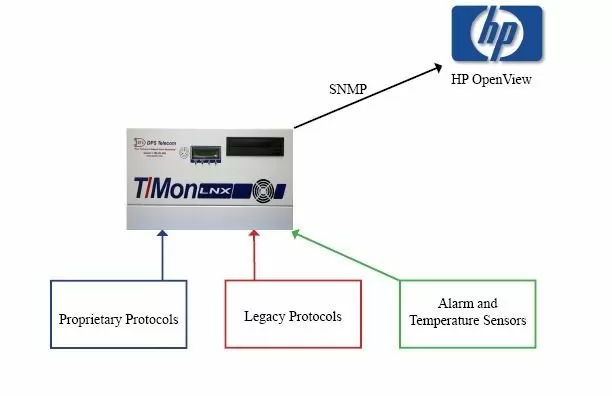
For organizations consolidating monitoring for mixed telecom and facility signals, DPS Telecom typically pairs centralized alarm management with RTUs at remote sites. RTUs can collect discrete alarms (dry contacts), analog readings (such as temperature), and other site signals, then deliver those events to T/Mon for unified presentation and escalation.
As part of building internal capability around the deployment, Bakhesh attended DPS Factory Training to learn more about the T/Mon system deployed at KNPC and the RTUs reporting into it.
"Training was amazing, more than I expected. I was really 'into' these classes."
The training covered fundamentals of the T/Mon environment, how RTUs report alarms, and how ASCII-based integration can be used to bring self-monitored or proprietary systems into a centralized alarm view. This helped support KNPC's goal of consolidating microwave, SDH, and TETRA monitoring while also expanding monitoring coverage for room sensors.
During training, Bakhesh learned about wireless options available for DPS Telecom RTUs. For remote sites without direct Internet access, cellular connectivity can provide a practical path to central monitoring without installing new hard-line connectivity.
"The GPRS modem, I didn't know DPS had that on RTUs. We have many remote sites that could make use of that."
In the NetGuardian series, a GPRS modem can provide cellular access for monitoring locations where an always-on wired connection is not available. This aligns with KNPC's need to monitor equipment rooms and remote sites while keeping alarm transport practical for field conditions.
By using T/Mon as a consolidation layer, KNPC established a way to bring multiple telecom monitoring domains into one operational interface. The approach supported centralized visibility for microwave, SDH, and TETRA radio systems, while also emphasizing the operational value of environmental monitoring (such as temperature alarms) in equipment rooms.
T/Mon's ability to output alarms via SNMP also created a straightforward integration path to HP OpenView when needed, helping KNPC maintain continuity with existing network management processes.
How does T/Mon help when each network has its own monitoring system?
T/Mon is used as an aggregation layer. It collects alarms and status from varied sources, normalizes what operators see, and reduces the need to swivel between multiple vendor tools.
What role does SNMP play in a consolidated monitoring architecture?
SNMP is commonly used for northbound integration to an NMS. In this case, T/Mon can output consolidated alarms in SNMP format and send them to HP OpenView if needed.
Can T/Mon support legacy or proprietary interfaces?
Yes. T/Mon is designed to integrate with a wide range of monitoring inputs, including legacy and proprietary equipment, so teams can consolidate without replacing every subsystem first.
How are temperature alarms and other room sensors typically brought into a monitoring system?
A remote site RTU (such as a NetGuardian) can collect sensor readings and threshold alarms, then deliver those events back to T/Mon for centralized presentation and escalation.
What are options for monitoring sites without wired Internet?
Cellular connectivity (such as a GPRS modem option on an RTU) can provide alarm transport for remote locations where a hard-line connection is not available.
If you are trying to consolidate monitoring across mixed telecom systems, remote equipment rooms, and legacy interfaces, DPS Telecom can help you design a practical alarm architecture using T/Mon and NetGuardian RTUs. Get a Free Consultation or call 1-800-693-0351 to speak with a DPS Telecom expert about your project.